
Logo

  • Home
  • For First-time Visitors
    • About the Network
      • Who We Are
      • How It Works
      • What We Do
      • Why We Exist
      • History
      • Contacts
    • Benefits and Success Stories
    • Getting Started
    • Network Grants
    • Sign up for EN Alerts
  • For Program Staff
    • Benefits and Success Stories
    • Find a Data Exchange
    • Network Grants
    • Find Data With the EN Browser
    • Data Exchange Status
  • For IT Staff
    • Getting Started Guide for IT Professionals
    • Download Node Software
    • Find Existing Data Exchanges
    • Knowledge Base and Technical Standards
    • Exchange Network Discovery Service
    • Find Data With the EN Browser

Sharing information for a cleaner environment

  • About
    • Who We Are
    • How It Works
    • What We Do
    • Why We Exist
    • Governance
      • Exchange Network Leadership Council
      • Network Technology Board
      • Upcoming Calls and Meetings
      • Integrated Project Teams
      • Acitivity Summaries
    • Network Grants
      • Apply for a Network Grant
    • Benefits and Success Stories
    • Contacts
      • Exchange Network Help Desk
  • Data Exchanges
    • Air
    • Cross-Program
    • Health
    • Natural Resources
    • Waste
    • Water
  • Partners
  • Knowledge Base
  • EN2014
  • EN Alerts
The Integrated Compliance Information System (ICIS) is replacing the legacy Permit Compliance System (PCS) for submission of wastewater permits, enforcement, compliance, and Discharge Monitoring Report (DMR) data. The data flows for inspections, permits, and effluent data families (including DMR) are now available.

BENEFITS

Partners can use the Exchange Network to flow their Permit and DMR data to EPA’s ICIS-NPDES system. Data flows for program reports and enforcement actions are in development.
A return on investment study for the EN showed a high return on investment from automating the DMR data flow.

ICIS-NPDES Flow Implementation Guide

Practical Implementation Advice

  • As of December 10, 2012, ICIS-NPDES Exchange Network data flows are available for all data families including permits, inspections, effluent, enforcement, and program reports.
  • Partners should participate in the ICIS-NPDES Integrated Project Team (IPT) to stay informed about development plans and timelines.
  • Direct users that manually enter data into ICIS-NPDES because they don’t have their own data system do not need to change their approach.
  • Partners that don’t already have electronic systems for collecting Discharge Monitoring Reports (DMRs) should consider implementing a demonstrated electronic DMR solution, such as NetDMR.

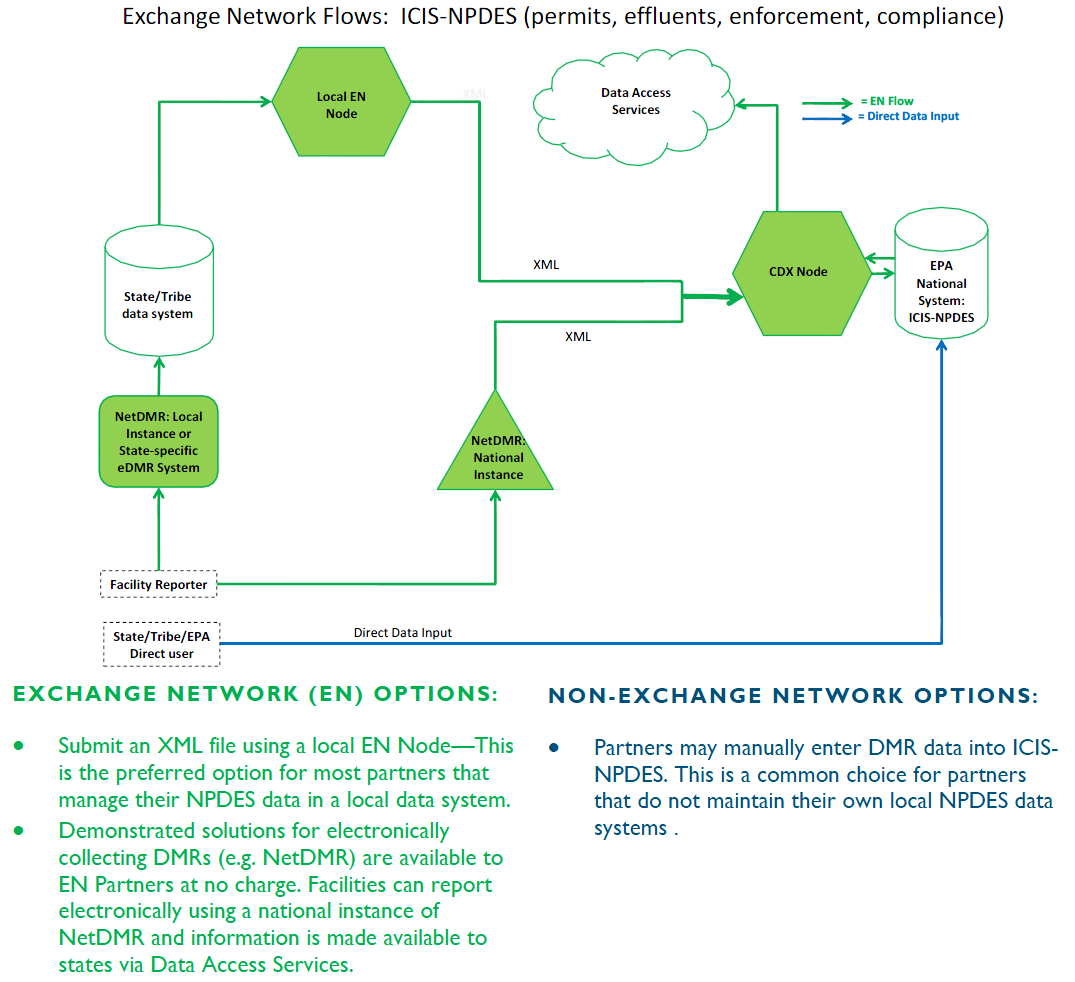
ICIS-NPDES Data Flow Options

The figure shows the current options for flowing permit, inspection, and DMR data to ICIS-NPDES. Exchange Network (EN) flow options are shown in green and the direct data input option is shown in blue. No other data exchange options are available for ICIS-NPDES.
ICIS-NPDES - Flow Implementation

Summary of Current Practice

The ICIS-NPDES data flows are now available for all data families including permits, inspections, effluent, enforcement, and program reports. Partners with their own local NPDES system can use their Exchange Network Node to submit this information to EPA. EPA currently provides an outbound service that allows States to access permit requirements data so that it can be used to support local instances of electronic DMR reporting systems such as NetDMR.

The OpenNode2 full batch plugins provide Partners using .NET or Java OpenNode2 with software tools to simplify the submission of data from the Partner’s NPDES information system to EPA’s ICIS-NPDES system and to download, process, and distribute ICIS transaction processing reports. Download the ICIS-NPDES plugins and documentation from the OpenNode2 Downloads page.

ICIS-NPDES Flow Status and Milestones

EPA and Network Governance are currently working to develop schema and supporting documentation for implementing flows for other data families beyond inspections, permits and DMRs. The ICIS-NPDES Batch Integrated Project Team (IPT) will be developing and testing new schemas for this data. Once all schemas are in production and ICIS is ready to receive the data, any Partner that wants to transmit data via the Exchange Network may do so. At this point, all States must have either already migrated to ICIS or be scheduled to migrate. The Office of Enforcement and Compliance Assurance (OECA) will shut down PCS six months after migration to ICIS-NPDES is complete (currently planned for December 2012). The table below shows institutional responsibilities and target completion dates for each activity.

Criteria Status Actions Primary Responsibility Completion
Period
Automation Ready Complete The IPT has completed the XML schema for all data families. They will be addressing enforcement action and violation schema in 2012. ICIS-NPDES Batch IPT  
Solutions for all Partners Complete No additional action is needed. The processing flow and schema that make up this solution will work for all partners interested in electronically reporting NPDES data to ICIS.    
Access to transaction status Complete Currently in production    
Accessible and stable flow documentation Complete      
Specifications for Data Access Services Complete      
Clear path to eliminate alternatives On Track


On Track

Support data migration for remaining States


Retire Permit Compliance System (PCS)

Office of Enforcement and Compliance Assurance (OECA)


OECA

Q4 2012


Q2 2013

Terms

Node: A Partner’s point of presence on the EN consisting of a server (hardware and software) enabled with web services that allow Partners to automatically provide and receive information via the Network and to publish data for use by other Partners.

Node Client: A stand-alone application (i.e., software code) that lets Partners share data, request data, and receive results from an EN request. Clients differ from nodes in that they cannot respond to queries from other nodes and so cannot publish data. Clients also need more manual (rather than automated) steps, for example, to extract data and generate and review reports before submission.

EN Services Center: A website that allows Partners to easily send, get, and download information from other Partners. The Services Center will serve as a replacement for manual submissions of information through CDX Web. It is an appropriate solution for those Partners who do not require or are not yet ready for the automation and data publishing capabilities of an EN Node. The EN Services Center is available at https://enservices.epa.gov.

CDX: EPA’s Central Data Exchange. It serves as EPA’s centralized electronic report receiving system. It receives data from Partners and directs the data to EPA’s program-specific National Systems (e.g., AQS, WQX, etc.).

CDX Node: CDX Node is EPA’s node on the Network, allowing EPA to receive, send, and provide information via the Network. CDX Node can also publish EPA data for use by other Partners.

CDX Web (non-EN) Application: A legacy CDX application that receives data (flat file or XML format) via standard web browsers. CDX Web applications are not consistent with EN protocols (e.g., they have a separate authentication and authorization service from the EN) and typically involve more manual steps than a node-to-node exchange of data.

Data Access Services: Using web services to make data available to Partners by querying nodes and returning environmental data in the form of XML documents. Published data can be accessed using a node or clients. Published data can be used in a number of ways, such as populating Web pages, synchronizing data between sites, viewing data in a Web service client, or building new sources of data into an integrated application.

Direct User: A Partner entering data directly into a National Data System through a system-specific interface (manual entry).

EPA National Data System: Program-specific data systems at EPA that can receive and publish data..

Local Data System: A Partner’s database or series of databases in which environmental data are stored, managed, and manipulated.

XML: eXtensible Markup Language is a flexible language for creating common information formats and sharing both the format and content of data over the Internet and elsewhere. The electronic language that expresses and transports data standards and transaction sets. XML uses an extensible set of tags to describe the meaning of data.

National System Flow “Ready-to-Use” Criteria

A focus of Governance has been developing the National System Flows to help Partners take advantage of the Network’s business value. Governance has identified six criteria for each flow to meet to make these flows “ready to use,” they are:

  • Automation-ready flows. Support fully automated node-to-node flows.
  • Solutions for all Partners. Provide appropriately scaled solutions for Partners of all sizes, needs, and capabilities. Some Partners such as Tribes and local clean air authorities may not need a fully functional node, therefore, other solutions should be available.
  • Access to transaction status. Support a fully automated process for reporting transaction status, processing results, and QA results from receipt by CDX through final processing in the National System.
  • Accessible and stable flow documentation. Develop and make accessible stable documentation that describes all flow requirements. This includes a complete Flow Configuration Document (FCD) that is in compliance with EN procedures for version management.
  • Specifications for Data Access Services. Provide a national standard set of query/solicit services defined in the FCD whether or not data are currently published. Implement a publishing interface where published data are critical to partner business processes (such as NPDES permit information for NetDMR).
  • Clear path to eliminate alternatives. Have a clear path to eliminate legacy system alternatives to data exchanges, including transition support for Partners.

Contact

Alison Kittle
U.S. Environmental Protection Angency
kittle.alison [at] epa.gov
202.564.6233

  • Home
  • About
  • Site Map
  • EN Alerts
  • Contacts
Share

© 2013 Network Technology Board