
Water

Profiles and Progress
Click the map to find contact information for Exchange Network Partners and to see Partners' progress toward implementing data exchanges on the Network.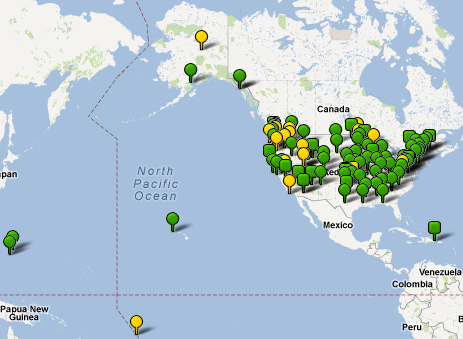
The following data exchanges are used by Network Partners to share water-related data.
Other
ICIS Data Submission
The Integrated Compliance Information System (ICIS) data exchange allows agencies to submit data in XML format to U.S. EPA’s ICIS database. Agencies can submit data for either the National Pollutant Discharge Elimination System (ICIS-NPDES) or air stationary source compliance and enforcement (ICIS-Air). News About Version 5.15 – Released January 26, 2026 Version 5.15 of the ICIS Data Submission …View Data Exchange
Assessment, TMDL Tracking And ImplementatioN System – ATTAINS
The Assessment, TMDL Tracking And ImplementatioN System (ATTAINS) data exchange allows EN Partners to submit 303(d)/305(b) water quality data, Total Maximum Daily Load (TMDL) information, and support program goals aligned with both submissions processes. A goal of the ATTAINS data exchange is to move the Integrated Reporting process to a paperless process using Exchange Network technology. The ATTAINS …View Data Exchange
Safe Drinking Water Publishing
Using the EN Browser and the SDWIS v3.5 schema, the New Jersey Department of Environmental Protection (NJ DEP) publishes its Safe Drinking Water Data. For more information, see NJ DEP’s Safe Drinking Water Outreach Guide.
ICIS Data Access
The ICIS Data Access data exchange (ICISDA) allows Partners to request and receive ICIS data in XML format. The Integrated Compliance Information System (ICIS) currently holds National Pollutant Discharge Elimination System (NPDES), Federal Enforcement and Compliance (FE&C), and Air compliance data. Partners can now request NPDES data such as permit, Discharge Monitoring Report (DMR), inspection, enforcement, violations, parameter …View Data Exchange
National Hydrography Dataset Update – NHDUpdate
The National Hydrography Dataset Update (NHDUpdate) data exchange enables the transmittal of updates to the National Hydrography Dataset (NHD) created by local updaters or state NHD data stewards to the national NHD data repository administered by the United States Geological Survey (USGS). The flow also enables USGS to send updates from the national repository to satellite NHD databases …View Data Exchange
National Hydrography Dataset Events – NHDEvent
The National Hydrography Dataset Events (NHDEvent) data exchange has been decommissioned as of September 2020. These resources are only available for reference purposes. Please do not attempt to implement this data exchange. The National Hydrography Dataset Events (NHDEvent) data exchange enables participants to submit spatial representations of surface water-related features. It supplements water program-related data flows that exchange surface …View Data Exchange
Ocean Data Partnership Exchange – ODPX
The Northeast and Coastal Ocean Data Partnership (NeCODP) developed the Ocean Data Partnership Exchange (ODPX) to accommodate a variety of non-regulatory environmental monitoring data types. The Partnership is composed of the New Hampshire Department of Environmental Services, Gulf of Maine Research Institute (GMRI), Canadian Department of Fisheries and Oceanography, National Oceanic and Atmospheric Administration Northeast Fisheries Science Center, …View Data Exchange
Beach Monitoring
Under the BEACH Act (Beaches Environmental Assessment and Coastal Health Act), grant recipients are required to submit beach monitoring data to U.S. EPA. The Beach Monitoring data exchange allows for the reporting of beach monitoring, station location, and sample and result data to EPA’s STORET Data Warehouse through the Water Quality Exchange (WQX). To report notification data, see …View Data Exchange
Beach Notification
Under the BEACH Act (Beaches Environmental Assessment and Coastal Health Act), grant recipients are required to submit beach notification data to EPA. The Beach Notification data exchange supports the reporting of beach meta data, contact information, and beach advisory and closing data. The Flow Implementation Guide provides a high-level overview of the data flow. To report monitoring data, see the …View Data Exchange
Chesapeake Bay Non-Point Source Best Management Practices
The U.S. EPA Chesapeake Bay Program Office (CBPO) Non-Point Source Best Management Practices (NPS BMP) Data Exchange allows Chesapeake Bay States to submit and solicit NPS BMP data to and from CBPO. Implementation Resources are available here.
Clean Water Act Integrated Reporting, Water Quality Assessment, Impaired Waters – OWIR
The OWIR-ATT data flow has been deprecated and replaced by the ATTAINS data flow. Please visit the ATTAINS Data Exchange page for information about that data flow. The OWIR data exchange allowed Partners to submit Integrated Reporting [303(d)/305(b)] water quality assessment data. This data set is taken from the Partner’s assessment data management system and submitted through its …View Data Exchange
Pacific Northwest Water Quality Exchange
The states of Oregon, Washington, Idaho, and Alaska developed the Pacific Northwest Water Quality Data Exchange to aggregate and access a comprehensive source of high-quality water data in the Pacific Northwest. Working together, the states developed XML schema to share water quality data. Each state then established a secure Network Node and began publishing the data in XML. Simple query …View Data Exchange
Water Quality Exchange – WQX
**IMPORTANT UPDATE April 13, 2020: Two new versions of the WQX data flow (v2.2 and v3.0) are now available and in production. EPA will continue to support existing versions of the WQX data flow. WQX Version 2.2 is 100% backwards compatible with v2.1 and provides expanded data element lengths for various key description text type elements. See the …View Data Exchange
Water Quality Data Exchange – WQDE
This exchange has been coordinated by the New Jersey Department of Environmental Protection’s Office of Information Resources Management and Water Monitoring and Standards Unit. The WQDE builds on the Water Quality eXchange (WQX) and features an enhanced WQX schema and web services for submitting project descriptions, images, and data. New Jersey developed robust tools for retrieving this information …View Data Exchange
Combined Animal Feeding Operations – CAFO
The Concentrated Animal Feeding Operation (CAFO) exchange makes state environmental data associated with CAFOs available on the Exchange Network. Under the Southeast CAFO Environmental Information Exchange pilot project, the U.S. Environmental Protection Agency (EPA) committed to develop a set of schemas and a node client that allows users to query multiple state nodes at once returning an aggregated …View Data Exchange
NetDMR
Built on previous efforts to create electronic discharge monitoring reports (eDMRs), NetDMR provides a generic, open-standards-based, CROMERR-approved, thoroughly documented eDMR system. See the NetDMR Success Story for more information its development. The NetDMR system is composed of a freely available web-based JAVA application for accepting electronic DMRs from permittees and for the regulatory authority to manage signatory user access, and Network-approved interfaces to …View Data Exchange
Safe Drinking Water Information System – SDWIS
This data flow allows users to submit data to the U.S. EPA’s Safe Drinking Water Information System (SDWIS). SDWIS is an EPA national database that contains information about public water systems and their violations of EPA’s drinking water regulations. Agencies submit federally reported drinking water data to EPA based on three separate subject areas (i.e., Inventory, Actions, and …View Data Exchange
Electronic Drinking Water Reports – eDWR
States have the primary responsibility for implementing and enforcing the drinking water standards promulgated under the Safe Drinking Water Act (SDWA). Most of the laboratory data the State Drinking Water Programs receive from either the state laboratories or private commercial laboratories come as paper documents that must be manually entered into the State’s information system. The manual entry …View Data Exchange
Underground Injection Controls – UIC
The Underground Injection Controls (UIC) data exchange has been decommissioned. These resources are available for reference purposes only. The UIC data exchange allowed Partners to share information on underground injection wells. The Safe Drinking Water Act established EPA’s Underground Injection Control Program to provide safeguards so that injection wells do not endanger underground sources of drinking water.