
Cross-Program

Profiles and Progress
Click the map to find contact information for Exchange Network Partners and to see Partners' progress toward implementing data exchanges on the Network.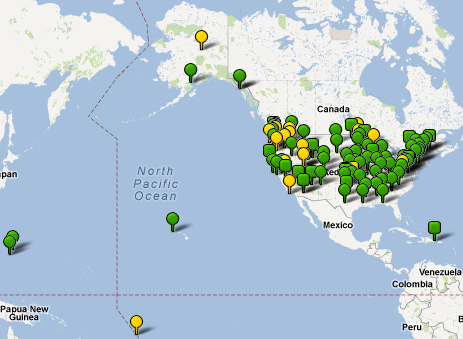
The following data exchanges are used by Network Partners to share data that may cross communities of interest or programs.
EPA Tribal Identification – TRIBES
UPDATE April 2023: U.S. EPA has replaced the Tribal ID data flow with a RESTful API. Please visit this link to access the new API. The resources below are only available for reference purposes and should not be used. The EPA Tribal Identification (TRIBES) data flow is a set of Web services that allow Partners to access and …View Data Exchange
Facility Identification – FacID
The Facility Identification (FacID) flow allows Partners to share their integrated facility/site data with EPA’s Facility Registry System (FRS) via their Exchange Network Nodes. Partners can use the Exchange Network to share information on facilities, sites, monitoring stations, and other place-based areas subject to environmental regulation or of environmental interest. The Flow Implementation Guide provides a high-level overview of the …View Data Exchange
Facility Registry System REST API
EPA’s Facility Registry System (FRS) offers a RESTful API to allow partners to share their integrated facility/site data with FRS. Partners can use the API to share information on facilities, sites, and other place-based areas subject to environmental regulation or of environmental interest. This RESTful API enables bi-directional exchange with FRS and takes advantage of FRS’s expanded data …View Data Exchange
Geospatial Data Exchanges
Exchange Network partners have identified various issues associated with the use and exchange of geospatial data on the Exchange Network. In late 2006, the Exchange Network Leadership Council (ENLC) convened an Exchange Network Geospatial Strategy Team to examine the following issues: What are the best options for encoding geospatial data for exchanges on the Exchange Network? What are …View Data Exchange
Homeland Emergency Response Exchange – HERE
The Homeland Emergency Response Exchange (HERE) allows Partners involved in emergency response planning and implementation to share available environmental, health, and natural resource information. Using the HERE flow, emergency planners can quickly identify potential dangers posed by chemical inventories or hazardous waste storage, allowing response teams to assess threats to drinking water infrastructure or other environmental interests. For additional …View Data Exchange
Homeland Security Data
The Homeland Security Data Exchange allows States to make their environmental, health, and safety information available to national security, law enforcement, and intelligence communities as well as the general public.
ICIS Data Access
The ICIS Data Access data exchange (ICISDA) allows Partners to request and receive ICIS data in XML format. The Integrated Compliance Information System (ICIS) currently holds National Pollutant Discharge Elimination System (NPDES), Federal Enforcement and Compliance (FE&C), and Air compliance data. Partners can now request NPDES data such as permit, Discharge Monitoring Report (DMR), inspection, enforcement, violations, parameter …View Data Exchange
Institutional Controls – IC
Institutional controls (IC) are non-engineered instruments, such as administrative and legal controls, that help minimize the potential for human exposure to contamination and protect the integrity of a remedial action. ICs can reduce exposure to contamination by limiting land or resource use and guide human behavior at a site. ICs are primarily used when residual contamination remains onsite …View Data Exchange
North American Industry Classification System – NAICS
The North American Industry Classification System (NAICS) classifies business establishments for the purpose of collecting, analyzing, and publishing statistical data. It is a standard business classification scheme used by the United States, Canada, and Mexico. Every five years, an updated set of NAICS codes is released. EPA’s System of Registries now includes the current standardized list of NAICS …View Data Exchange
Pollution Prevention Reporting
The Colorado Department of Public Health and Environment (CDPHE), the Pacific Northwest Pollution Prevention Resource Center (PPRC), the Pollution Prevention Resource Exchange Network (P2Rx), the National Pollution Prevention Roundtable, and the Environmental Protection Agency, entered into a cooperative agreement to exchange regional and national Pollution Prevention (P2) measurement data. The project is a collaborative process involving CDPHE and …View Data Exchange
Risk Management Plan Report – RMPREPORT
The Risk Management Plan (RMP) RMPREPORT process allows an EPA-approved recipient to obtain RMP data from EPA’s RMP Database. Recipients may include EPA Regions, States, Territories, Tribes, and Local Emergency Planning Committees that meet RMPREPORT receipt requirements. The RMPREPORT flow is designed to submit RMP data to a recipient node. The RMPREPORT data exchange is configured to obtain …View Data Exchange
Substance Registry Services – SRS
The Substance Registry Services (SRS) is the U.S. Environmental Protection Agency’s (EPA) central registry for information about regulated and monitored substances. The SRS provides a common basis for identification of chemicals, biological organisms, and other substances listed in environmental statutes and EPA data systems, as well as substances of interest from other sources, such as other Federal agencies or …View Data Exchange
Toxics Release Inventory – TRI
The Toxics Release Inventory (TRI) is an EPA program enacted as part of the Emergency Planning and Community Right to Know Act (EPCRA) of 1986. Every year, tens of thousands of facilities in the United States submit reports to EPA and the States on releases and other waste management of certain toxic chemicals. Facilities are required to use the Toxics Release …View Data Exchange