
Air

Profiles and Progress
Click the map to find contact information for Exchange Network Partners and to see Partners' progress toward implementing data exchanges on the Network.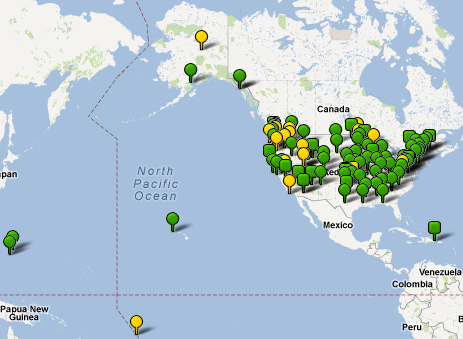
The following air-related data exchanges have been developed for the Network.
Air Quality Data Exchange – AQDE
New Jersey, New York, and Delaware share common airsheds. Air transported into the area and emission sources in and across these States impact one another. Each State benefits from information on the quality of the air in another State. This information is used in the evaluation of current environmental conditions and trends, health tracking, and in coordinating homeland … View Data Exchange
Air Quality System – AQS
Partners can use the Exchange Network to submit data to EPA’s Air Quality System (AQS). AQS is the national database that contains ambient air quality monitoring data collected by States, Tribes, and local governments. These data are used to determine compliance with clean air standards, assess the nature of air pollution in North America, and assess the exposure of … View Data Exchange
Ambient Radiation Publishing
The New Jersey Department of Environmental Protection (NJDEP) publishes its ambient radiation data. Leveraging EN technology, NJDEP implemented a minute-by-minute ambient radiation solicit service that can automatically pull ambient radiation from NJDEP’s air quality data views, and generate the data in the AQS Schema format. For more information, see NJDEP’s Ambient Radiation Outreach Guide.
Combined Air Emissions Reporting System – CAERS
Industry partners can utilize the Combined Air Emissions Reporting System (CAERS) to report air emissions to meet reporting requirements. CAERS provides outbound data across services that enable State, Local, and Tribal authorities to download air emissions data that was reported in CAERS. These outbound services provide CAERS reporting data using the same JavaScript Object Notation (JSON) schema used by industry … View Data Exchange
Consolidated Emissions Reporting Schema
In March 2008, EPA initiated the development of the Consolidated Emissions Reporting Schema (CERS). The objective of this effort was to develop a common air emissions reporting schema that could be used for sharing and reporting air pollution emissions data. The schema is designed to support the reporting of criteria air pollutants and air toxic emissions, as well as … View Data Exchange
Emissions Inventory System – EIS
The Emissions Inventory System (EIS) is EPA’s information system for storing all current and historical emissions inventory data. It is used to receive and store emissions data and generate emission inventories beginning with the 2008 National Emissions Inventory (NEI). Partners use the EIS Exchange to submit Facility Inventory, Point, Nonpoint, Onroad, and Nonroad data categories to the EIS Production … View Data Exchange
EPA Moderated Transaction System – EMTS
Under the Energy Independence and Security Act of 2007 (EISA), EPA is responsible for revising and implementing regulations to ensure that transportation fuel used in the United States contains a minimum volume of renewable fuel. The Renewable Fuel Standard Program (RFS2) has been developed in collaboration with refiners, renewable fuel producers, and many other stakeholders. RFS2 incorporates the concept … View Data Exchange
ICIS Data Access
The ICIS Data Access data exchange (ICISDA) allows Partners to request and receive ICIS data in XML format. The Integrated Compliance Information System (ICIS) currently holds National Pollutant Discharge Elimination System (NPDES), Federal Enforcement and Compliance (FE&C), and Air compliance data. Partners can now request NPDES data such as permit, Discharge Monitoring Report (DMR), inspection, enforcement, violations, parameter … View Data Exchange
ICIS Data Submission
The Integrated Compliance Information System (ICIS) data exchange allows agencies to submit data in XML format to U.S. EPA’s ICIS database. Agencies can submit data for either the National Pollutant Discharge Elimination System (ICIS-NPDES) or air stationary source compliance and enforcement (ICIS-Air). News About Version 5.11 – Updated March 19, 2024 An updated version of the v5.11 ICIS … View Data Exchange
MassAir
The Massachusetts Department of Environmental Protection developed the MassAir data exchange to: Display near real-time ambient air quality data, allow the download of recent pollutant data, and educate the public about the nature of air quality, how it affects their health, and what they can do to improve it; Provide a suite of quality assurance tools that partially … View Data Exchange
Radon
U.S. EPA, States, and Tribes all collect radon data, however, different programs collect different data fields, have different thresholds and calculation logics, and use the data in different formats. RadonLeaders.org developed a standard process to share radon data and promote radon data exchange in a more standard way, including identifying a list of core data elements. Using those … View Data Exchange