Logo

  • Home
  • For First-time Visitors
    • About the Network
      • Who We Are
      • How It Works
      • What We Do
      • Why We Exist
      • Contacts
    • Benefits and Success Stories
    • Getting Started
    • Network Grants
    • Sign up for EN Alerts
  • For Program Staff
    • Benefits and Success Stories
    • Find a Data Exchange
    • Network Grants
    • Find Data With the EN Browser
    • Exchange Network Progress
  • For IT Staff
    • Getting Started Guide for IT Professionals
    • Download Node Software
    • Find Existing Data Exchanges
    • Build a New Data Exchange
    • Knowledge Base and Technical Standards
    • Exchange Network Discovery Service
    • EN Browser

Sharing information for a cleaner environment

  • About
    • Who We Are
    • How It Works
    • What We Do
    • Why We Exist
    • Benefits and Success Stories
    • Network Grants
      • Apply for a Network Grant
    • Network Governance
      • Exchange Network Leadership Council
      • Network Operations Board
      • Network Technology Group
      • Network Partnership and Resources Group
    • Contacts
      • Exchange Network Help Desk
  • Data Exchanges
    • Air
    • Cross-Program
    • Health
    • Natural Resources
    • Waste
    • Water
  • Progress
  • Knowledge Base
  • Meetings and Events
  • News
  • Who We Are
  • How It Works
  • What We Do
  • Why We Exist
  • Benefits and Success Stories
  • Network Grants
    • Apply for a Network Grant
  • Network Governance
    • Exchange Network Leadership Council
    • Network Operations Board
    • Network Technology Group
    • Network Partnership and Resources Group
    • Tribal Governance Group
    • Environmental Information Technology Leadership Council
    • Network Policy Framework
  • Contacts
    • Exchange Network Help Desk
Home > About > How It Works

How It Works

Using the Exchange Network, you’ll connect to the EPA and other Network Partners securely via the Internet. Then you’ll start exchanging environmental data completely free from common compatibility problems. Here’s how it works:

Partners
create
agreements
Data Publishers
maintain
dedicated
computer
XML provides
standard data
structures
Partners
exchange
information.
Seamlessly

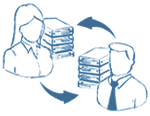
Through trading partner agreements, Partners define how they will use the Exchange Network. An agreement will clearly state the kind of data the Partners will share, how frequently they will share it, and in what format it will appear.

After Partners decide what data they will exchange and with whom, each sets up a computer dedicated to sharing data over the Exchange Network. Depending on a Partner's needs, we call this computer a "node" or "node client."

With a node client, Partners can send, receive, and request environmental data over the Network. A node does the same thing, but with the added benefits of automated data delivery and the ability to monitor requests from other nodes.

The choice between node and node client depends on whether your organization needs automated monitoring of data requests. While a node gives you that ability, a node client offers a "lightweight" way for you to connect with Exchange Network Partners.

A major problem environmental agencies face is system incompatibility that slows down the data exchange. We fix that by using Extensible Markup Language or XML.

XML is just a data format. It's the common format nodes use to "talk" to one another. Since all data shared on the Network uses XML, all Partners' data structures are compatible. It's through XML that we standardize all data shared on the Network.

It's also what makes the Exchange Network so powerful.

Once Partners connect to the Network, they're ready to share data. Every Partner has a Network node or node client, and they all communicate through XML. These defining characteristics of our Network are what make it easy for Partners to exchange of information.

Thanks to the Exchange Network, environmental agencies are turning what was once a tedious exercise–data exchange–into an automatic one.

  • Home
  • About
  • Site Map
  • News
  • Contacts
Share

© 2011 Network Operations Board Send questions or comments about this site to gmcnelly [at] ecos.org

DC Web Developer: inQbation